
Complete Guide of Making a Will in Malaysia for Non-Muslims (2026)

How to Make a WilL(Wasiat) in Malaysia 2026 – A Complete Guide for Non-Muslims
Introduction
Planning for the future is an important step many Malaysians consider as they build their lives and accumulate assets. For non-Muslims in Malaysia, a will (“wasiat”) is a legal document that allows you to express your wishes on how your assets should be distributed after your passing.
Under the Wills Act 1959 (which applies to non-Muslims in Peninsular Malaysia), creating a valid will can help provide clarity for your loved ones and potentially reduce complications during the probate process. This guide outlines the key requirements, steps and considerations for making a will in Malaysia in 2026.
Who Can Make a Will in Malaysia?
To make a valid will as a non-Muslim:
- You must be at least 18 years old (or 21 years old in Sabah).
- You must be of sound mind at the time of making the will, meaning you understand the nature and effect of the document.
Foreigners who own assets in Malaysia may also make a will governing those assets, subject to the same rules. Note that Muslims in Malaysia are generally governed by Syariah law (Faraid) for inheritance matters, so this guide focuses on non-Muslims.
Legal Requirements for a Valid Will
For a will to be legally recognised in Malaysia under the Wills Act 1959, it must meet these essential requirements:
- It must be in writing (handwritten, typed, or printed). Oral or purely digital wills (e.g., video or WhatsApp messages) are not valid.
- The testator (the person making the will) must sign the will at the end or affix a thumbprint if unable to sign.
- The signing must take place in the presence of at least two witnesses who are present at the same time.
- The two witnesses must then sign the will in the presence of the testator and each other.
- The witnesses should generally not be beneficiaries under the will to avoid potential complications.
The will can be written in any language but it is advisable to use clear and unambiguous wording.
Step-by-Step Guide to Making a Will
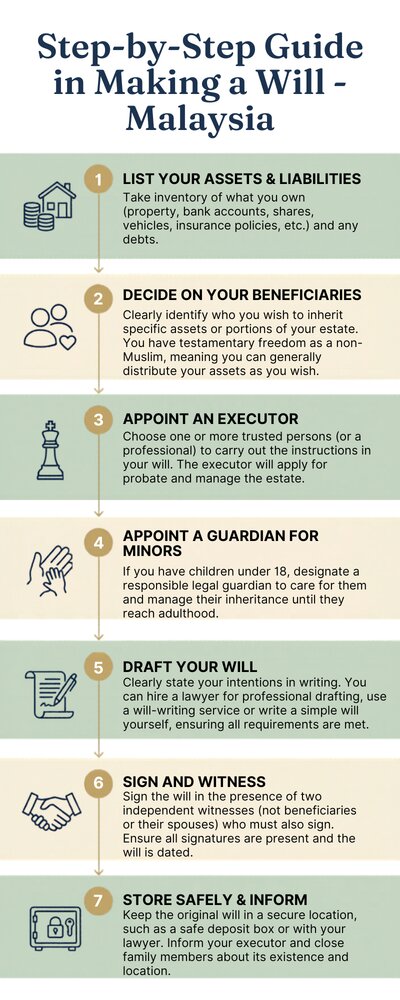
- List Your Assets and Liabilities – Take inventory of what you own (property, bank accounts, shares, vehicles, insurance policies, etc.) and any debts.
- Decide on Your Beneficiaries – Clearly identify who you wish to inherit specific assets or portions of your estate. You have testamentary freedom as a non-Muslim, meaning you can generally distribute your assets as you wish.
- Appoint an Executor – Choose one or more trusted persons (or a professional) to carry out the instructions in your will. The executor will apply for probate and manage the estate.
- Consider Guardianship (if applicable) – If you have minor children, you may appoint a guardian in your will.
- Draft the Will – You may draft it yourself, use an online template (with caution) or engage a lawyer. Professional drafting helps ensure clarity and validity.
- Sign and Witness the Will – Follow the witnessing requirements strictly.
- Store Your Will Safely – Keep the original in a secure place (e.g., safe deposit box) and inform your executor of its location. You may also consider safe custody services offered by some law firms.
What Happens If You Die Without a Will?
If a non-Muslim passes away without a valid will (intestacy), distribution of the estate follows the Distribution Act 1958. This fixed formula may not reflect your personal wishes and can lead to delays and higher costs.
Conclusion:
Making a will is a responsible step that can bring peace of mind to you and your family. While it is possible to draft a will yourself, seeking professional legal advice can help ensure the document is clear, valid and tailored to your circumstances.
For personalised advice on your specific situation regarding estate planning, you may book a no-obligation 15-minute call with us. Feel free to read our previous post related to divorce.
Messrs Srileena & Sui is a law firm in Petaling Jaya, Selangor, handling matters related to wills, probate and letters of administration.